AI companies publish a lot of promises. Almost none of them are ever checked again.
Look at the past two weeks. NVIDIA said a 64GB version of its DGX Spark desktop AI computer goes on sale October 23 through Acer, ASUS, Dell, Gigabyte, HP and MSI, starting at $4,999. Mistral said it will publish the weights of Mistral Large 4, its trillion-parameter model, before the end of October. Anthropic said it is expanding a Cyber Verification Program that vets security researchers for access to Claude’s cyber capabilities.
Read those three sentences again. Each one names a date, a number, or a specific commitment. Each one can be checked six weeks later. Almost none of them will be.
That gap is what AI Rank Bank is built around.
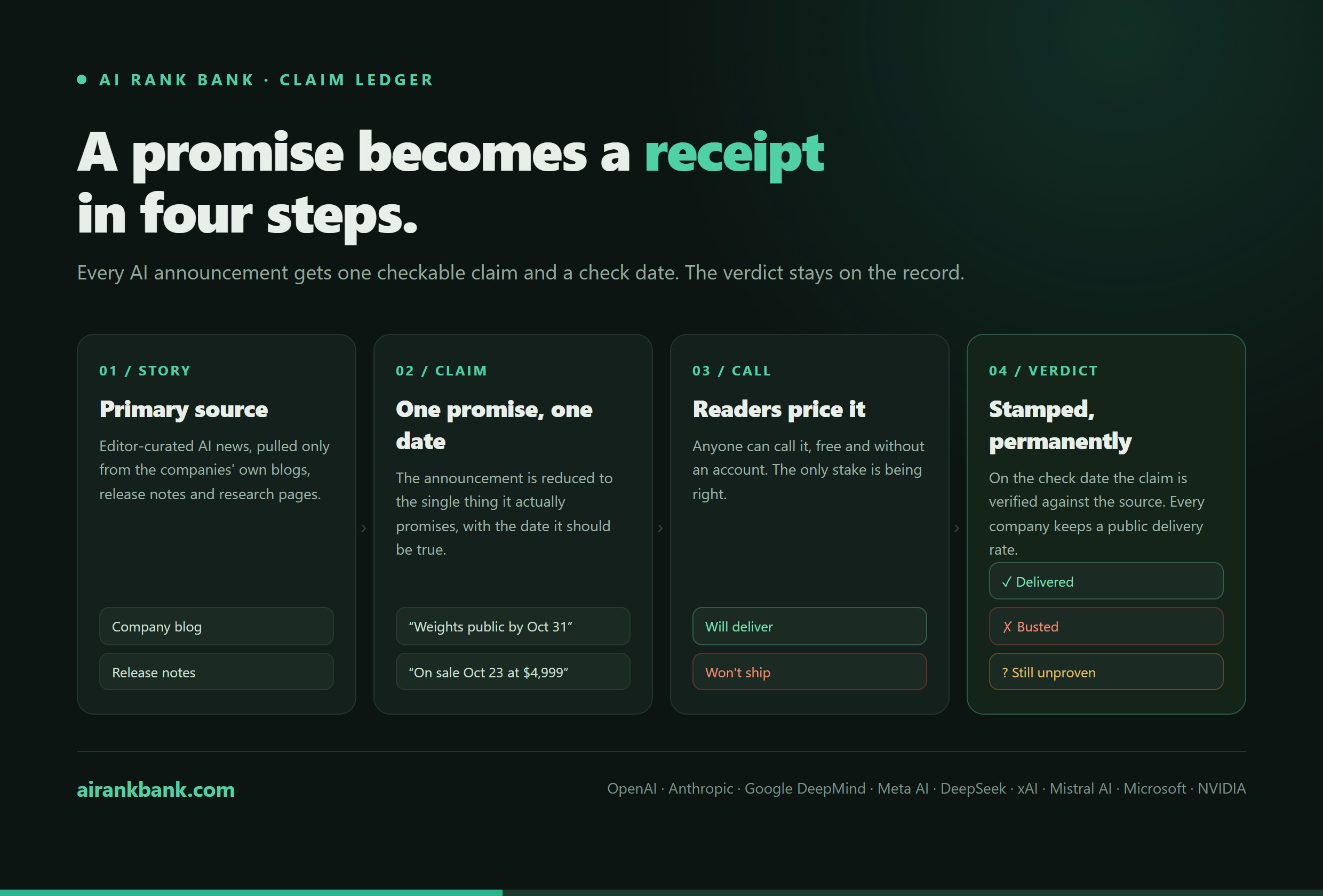
One story, one claim, one check date
The site runs a short, editor-curated list of AI news. Stories come from primary sources only, the companies’ own blogs, release notes and research pages. There is no rewriting of other outlets’ coverage, and the list stays deliberately short. When nothing meaningful shipped, the list is shorter that day.
What happens next is the part that differs from a normal feed. Every story carries exactly one checkable claim and one check date: the thing the announcement actually promises, and the date by which it should be true.
The NVIDIA story becomes a claim about whether DGX Spark 64GB really goes on sale on October 23 at $4,999.
The Mistral story becomes a claim about whether those weights actually ship publicly by October 31.
The Anthropic story becomes a claim about whether the company publishes its vetting criteria or names its first verified participants.
Readers then call it. Two buttons: Will deliver or Won’t ship. Calling is free, and it takes no account.
The verdict is the product
On the check date, the claim gets verified against the source and stamped one of three ways: ✓ Delivered, ✗ Busted, or ? Still unproven.
Then the important word. Verdicts are permanent.
A news site moves on. A ledger does not. Every company tracked here has its own bank page holding the full list of claims, dates and verdicts, plus the delivery rate those verdicts add up to. OpenAI, Anthropic, Google DeepMind, Meta AI, DeepSeek, xAI, Mistral AI, Microsoft and NVIDIA all have one.
A company that ships what it announces watches its rate climb. A company that announces broad and narrows later watches it fall, one dated receipt at a time. You can read OpenAI’s record at airankbank.com/bank/openai.
Scoring rewards being right alone
The leaderboard pays for accuracy against the crowd, not for agreeing with it.
A correct call earns 100 × (1 − the share of readers who agreed with you when you called it), floored at 10 points. Wrong calls earn nothing. Agree with 90% of the crowd and get it right, you collect 10 points. Stand alone and get it right, you collect close to 100.
Five settled calls are required before you appear on any board. Below that, the site’s own words, it is luck, not a record. The weekly board resets every Monday at 00:00 Eastern Time, so a bad week is never more than seven days long.
As of early October 2026, nobody qualifies yet. The first big settlement day is October 23, when the NVIDIA claim and a batch of others come due. The current front page shows Anthropic’s Cyber Verification claim priced at 75% deliver with 4 calls in, while Atlassian and OpenAI’s partnership claim sits at 100% with a single call placed.
What this actually measures
Most AI coverage is a record of what companies said. This is a record of whether they did it.
The difference sounds academic until you spend an hour reading a company’s claim list. Some promises are narrow and checkable by design. SynthID Bio opening to external partners. Microsoft’s MAI-Transcribe-2-Streaming holding its introductory price through the end of 2026. Others are broad enough that almost any follow-up announcement counts, which is where a check-date design earns its keep: the claim has to be pinned down before anyone can bet on it, and pinning it down is half the work.
The other half is refusing to let a missed date quietly disappear. A model that gets announced, then narrowed, then renamed, then folded into a bigger launch normally leaves no trace. Here it leaves a ✗ and a delivery rate that follows the company around.
Honest about its own limits
AI Rank Bank is one person’s publication, and the about page says so plainly. A human editor picks the stories. Verdicts are that editor’s judgement based on public evidence, which means a verdict can be argued with. The site takes challenges through a contact page and says it will correct the record publicly if the evidence says a stamp was wrong.
That is a real limitation, and also the honest version of it. A one-person ledger with a correction path beats an automated score nobody can appeal.
Why it is worth a look
The AI industry has spent three years optimizing the announcement. The verification layer never got built, because nobody’s growth chart depends on it.
What is missing is a cheap way to ask, six weeks later, whether the thing happened. A dated claim, a public call, a permanent verdict. It is a small mechanism, and it turns a feed of press releases into something you can actually score.
Start with a company you follow, pick a claim you have an opinion about, and see if you beat the crowd: airankbank.com